 TribuSplit
How to split expenses as a couple: methods and examples
There's no single right way for couples to split costs, only the one that works for both of you. What matters is choosing it deliberately and that both of you feel it's fair.
Why it's worth talking about
In many couples the split just happens: one pays rent because the lease is in their name, the other buys groceries because they pass the store. It works for a while, until amounts change (rent goes up, a baby arrives, someone changes jobs) and the "I always pay" feeling shows up without anyone doing anything wrong.
Choosing an explicit method isn't distrust. It's having a shared rule for when things change. These are the four most common, with their benefits and their traps.
Method 1: 50/50
Every shared expense is split evenly. Simple, transparent, and no need to discuss salaries.
Works well when: incomes and spending habits are similar.
The trap: when one partner earns much more, the other ends up spending a much larger share of their income on shared costs. With 2,000 rent and incomes of 6,000 and 3,000, one spends 17 % of their income on rent and the other 33 %.
Method 2: proportional to income
Each partner contributes according to what they earn.
| Income | Share | Pays of 2,000 rent | |
|---|---|---|---|
| Partner A | 6,000 | 60 % | 1,200 |
| Partner B | 4,000 | 40 % | 800 |
Works well when: incomes differ significantly and both want the effort to feel similar.
The trap: it requires talking openly about pay and updating the ratio when it changes. With variable income (freelance, commissions), review it every few months.
Method 3: a joint account
Both put a fixed amount each month (equal or proportional) into a shared account, and shared costs come out of it. No splitting individual expenses: the account pays and that's it.
Works well when: you've lived together a while and shared costs are stable.
The trap: when the account runs short, someone covers it "just this once" and the account stops reflecting reality. Review contributions regularly.
Method 4: by category
One covers rent, the other groceries and utilities. Practical, because each pays "their bills" with no transfers.
The trap: category costs drift. Groceries rise every month, rent adjusts once a year, and the split can become lopsided without anyone noticing. Check it now and then.
Quick comparison
| Method | Simplicity | Fair with unequal incomes | Upkeep |
|---|---|---|---|
| 50/50 | High | Low | Low |
| Proportional | Medium | High | Medium |
| Joint account | High day to day | Depends on contributions | Medium |
| By category | High | Variable | High (drifts) |
Trips as a couple
Many couples use one method at home and another for travel: proportional for the household, 50/50 for vacations, or the other way round. Decide before booking.
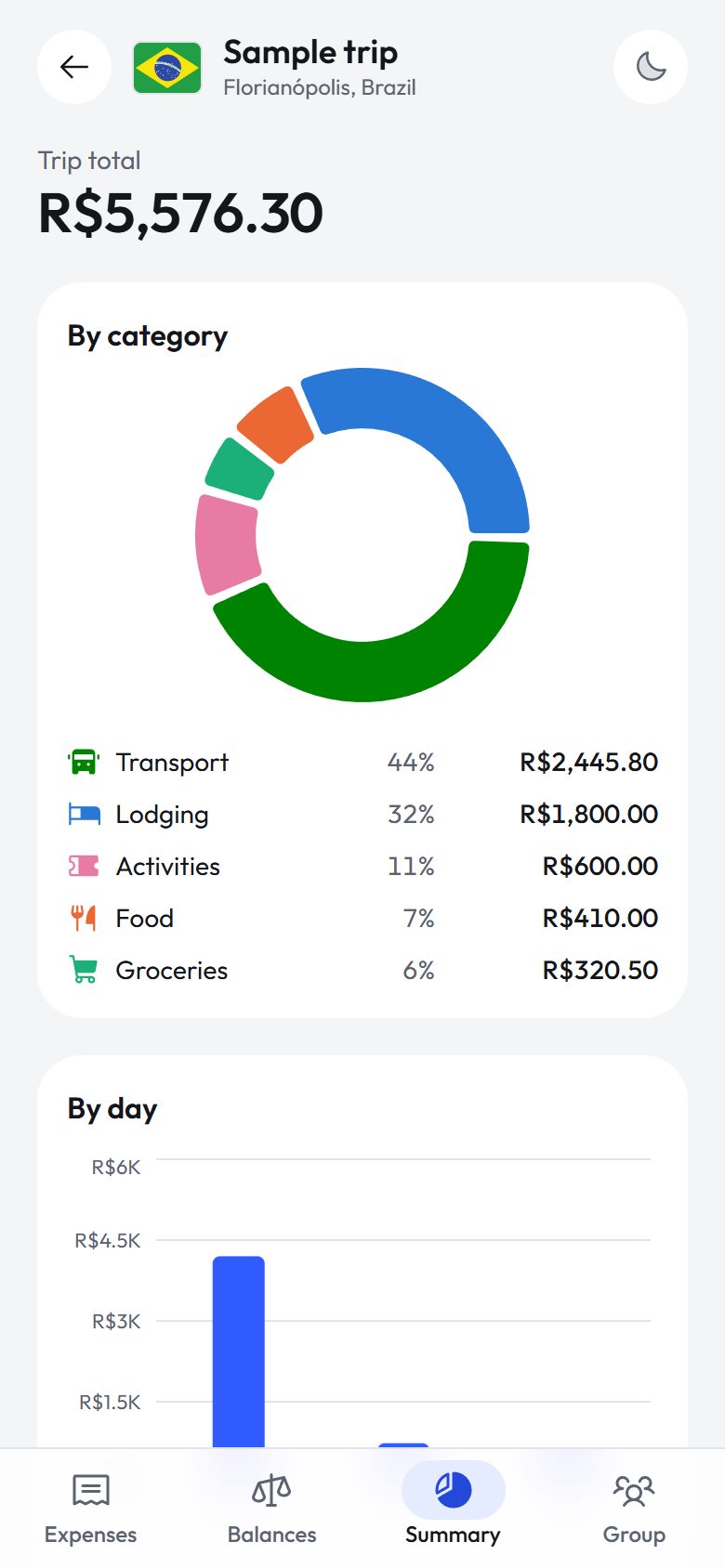
On a trip there are many small expenses and both of you pay for different things all the time. Logging them as you go and settling once at the end is far easier than paying each other back after every meal. And if you want to see where the money went, the summary by category shows it.
Things worth deciding explicitly
- Are trips and nights out split the same way as household costs?
- What about gifts, each other's families, or pets?
- How do you handle individual purchases that benefit both (a coffee machine, a sofa)?
- What happens if one of you is out of work for a while?
- How often will you review the arrangement?
Keeping a record helps more than you'd think
Even with complete trust, logging shared expenses prevents the "I always pay" feeling. It's not about monitoring each other; it's having data instead of impressions. With a record, the conversation shifts from "I feel like I put in more" to "I paid 120 more this month, shall we even it out or carry it over?"
Signs your current method isn't working
- One of you avoids talking about money or gets defensive.
- Phrases like "I always pay" or "you never chip in" start appearing.
- Someone stops suggesting plans because they're not sure they'll be asked to pay half.
- Small expenses cause more friction than big ones.
If any of these show up, it's not a failure: it's time to revisit the arrangement. How to talk about money has ideas for the conversation, even if it's written with friends in mind.