 TribuSplit
Solo travel budget: how to work out how much to spend per day
Traveling solo has one huge advantage for your budget: you decide everything. And one drawback: nothing gets split. With a simple daily spending number, you can enjoy the trip without constantly wondering whether you're overspending.
What changes when you travel alone
On a group trip, accommodation, a rental car or fuel get split. Traveling solo, those costs are entirely yours. That's why accommodation is usually the biggest part of a solo budget, and where you can save the most: hostels with private rooms, small apartments or longer stays with a discount.
In exchange, everything else is flexible. You can eat at the market instead of a restaurant, walk instead of taking a taxi, or change plans without asking anyone. A daily budget gives you that freedom without losing control.
1. Separate fixed costs from daily costs
Fixed costs are paid once and don't depend on what you do each day: flights, accommodation, travel insurance, a tour booked in advance. Daily costs are the ones you decide on the ground: meals, local transport, tickets, nights out, small purchases.
An example with illustrative numbers, a week in Lisbon:
| Item | Type | Amount |
|---|---|---|
| Round-trip flight | Fixed | paid before |
| Hostel, private room, 6 nights | Fixed | €420 |
| Day trip to Sintra, booked | Fixed | €45 |
| Meals, transport, nights out | Daily | whatever is left |
2. Work out your daily number
The formula is: (total budget − fixed costs − buffer) ÷ days of the trip.
Following the example: if you have €1,000 for the stay, subtract the fixed costs (€465) and a 10% buffer (€100). That leaves €435 for seven days: about €62 a day.
That number is your compass. A beach day with a cheap lunch will come in under; the night of the special dinner, over. What matters is the average.
3. Keep a buffer for surprises
Something always comes up: a late-night taxi, a pharmacy, a ticket that wasn't in the plan, a rainy day that ends in a museum. A practical rule is to set aside 10 to 15% of the budget. If you don't use it, it's a treat for the last day.
4. Think in one currency
Build the budget in the local currency, since that's what you'll see on price tags, and keep in mind what it means in your own. That's what the travel currency converter is for: it has a quick table of round amounts you can save as a screenshot.
5. Track your spending during the trip
A budget only works if you compare it with what you actually spend. The simplest way is to log each expense right away and watch your daily average. In TribuSplit, if you create the trip in solo mode, the main screen shows the total, its equivalent in your currency and your average per day.
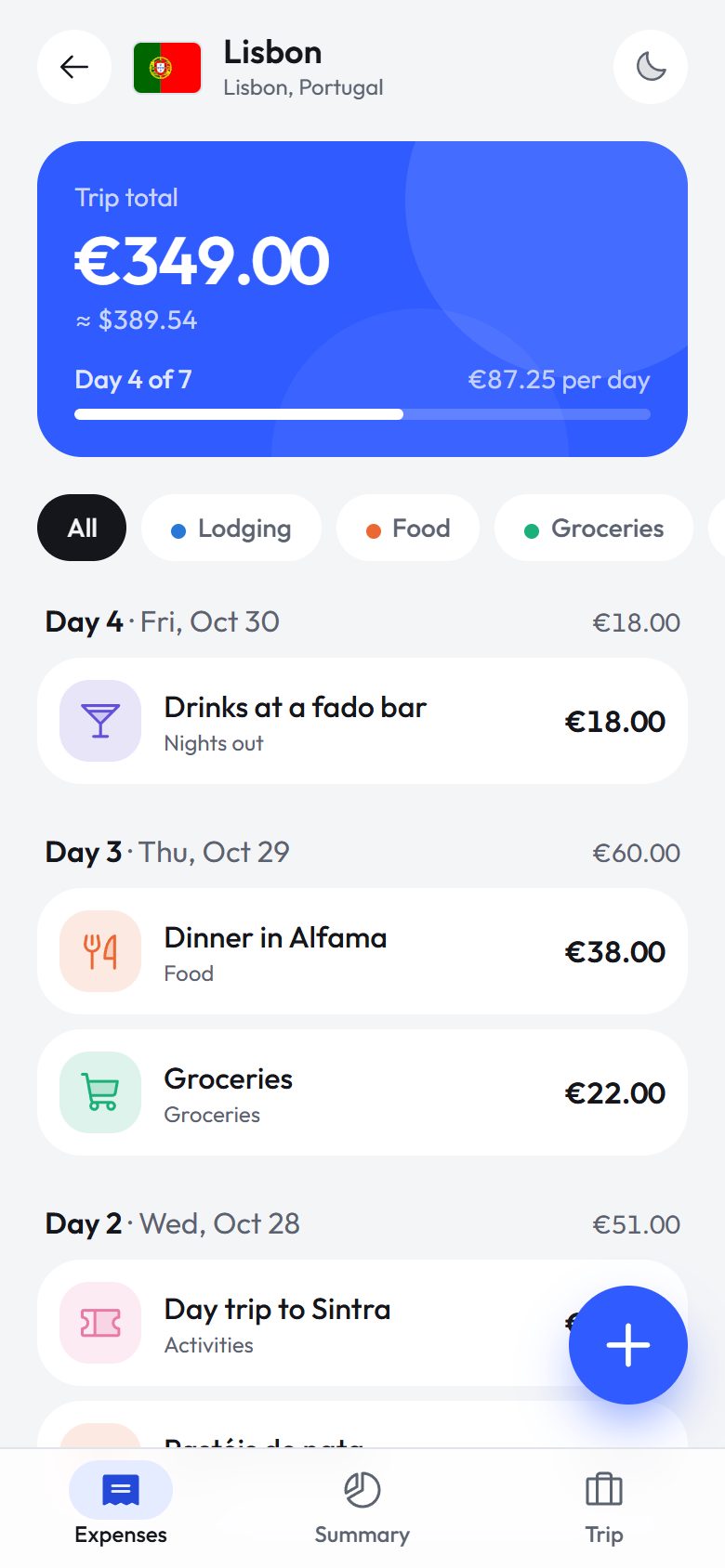
If by day three you're above your number, there's no need to cut everything: a couple of quieter days will bring the average back. We go through it step by step in how to track your travel expenses.
Ways to stretch the budget
- One proper meal out per day, and the rest from the supermarket or a market stall.
- Public transport and walking instead of taxis, except late at night or with luggage.
- Free activities: beaches, viewpoints, free walking tours (tip-based).
- Pay in the local currency when the card terminal asks: the merchant's conversion is usually worse.
FAQ
How much cash should I bring?
It depends on the destination. In many places a card covers almost everything and cash is for small purchases; in others, cash is still king. Our guide to paying abroad with cards and cash covers the trade-offs.
Should I budget in my home currency?
For the overall total, yes: it's what you earn and save in. Day to day, it's more practical to think in the local currency, since that's what prices are in.
What if I go over budget?
Look at which category the difference came from. If it was nights out or meals, it's easy to balance out; if it was something unexpected, that's what the buffer is for.
In short: separate fixed from daily costs, work out your daily number, keep a buffer and track your average as you go. Traveling solo with a clear number in mind means traveling with peace of mind.