 TribuSplit
Paying abroad: cards, cash and how to avoid hidden fees
The exchange rate you see online is rarely the one you get. Between card fees, ATM charges and bad conversions, a trip can quietly cost several percent more than it should.
Where the money actually goes
When you pay in another currency, there are up to three layers of cost on top of the price:
- The exchange rate itself: the rate your card network or bank applies, usually close to the market rate but not identical.
- Foreign transaction fees: a percentage many banks add to every purchase in another currency. It's often around 1 to 3 %, and some cards charge nothing. Check your card's fee schedule before you leave.
- ATM fees: your bank may charge for withdrawals abroad, and the local ATM operator can add its own fee on top.
None of these show up on the receipt, which is why they're easy to miss. On a 2,000 trip, a 3 % fee is 60 you never decided to spend.
Always pay in the local currency
Card terminals and ATMs abroad often offer to charge you "in your home currency". This is called dynamic currency conversion, and the rate it uses is usually worse than your own bank's. The rule is simple: when asked, choose the local currency, and let your bank do the conversion.
The same goes for ATMs: if the screen offers to "lock in" a conversion rate, decline and continue in the local currency. Some machines make the bad option the big green button; read before you tap.
Cards vs cash
| Card | Cash | |
|---|---|---|
| Exchange rate | Usually close to market | Depends on where you exchange |
| Fees | Foreign transaction fee, if your card has one | ATM fees or exchange spread |
| Safety | Can be locked from your bank's app | Lost is lost |
| Record keeping | Automatic in your statement | Easy to forget |
| Acceptance | Near universal in cities | Needed at markets, small shops, tips |
For most trips, the best combination is a card without foreign transaction fees for most purchases, plus a small amount of cash for markets, tips and places that don't take cards.
Getting cash without overpaying
- Withdraw less often, in larger amounts, if your bank charges a fixed fee per withdrawal.
- Use bank ATMs rather than standalone machines in tourist areas, which tend to charge more.
- Avoid airport exchange counters for anything beyond what you need to reach your lodging.
- Carry a backup card from a different bank in case one gets blocked.
A quick comparison with numbers
Say you spend 1,000 euros on a trip and the market rate is 1 euro = 1.08 dollars. With illustrative fees:
| How you pay | Approximate cost in dollars |
|---|---|
| Card with no foreign fee | ~1,080 |
| Card with a 3 % foreign fee | ~1,112 |
| Accepting dynamic conversion at the terminal | often 1,130 or more |
| Cash exchanged at an airport counter | often 1,150 or more |
Exact figures depend on your bank and the place, but the order rarely changes: fee-free card first, airport counters last.
What this means when you split costs with a group
When people pay in different ways (one by card, another with cash from the airport) each effectively paid a slightly different rate. Tracking each person's exact rate gets complicated fast. Two simpler approaches work well:
- Log every expense in the local currency, the amount on the receipt. That keeps the shared record exact and fair.
- Agree on one exchange rate when you settle up, such as the market rate on the day you settle, or the card rate if most of the money was fronted by card.
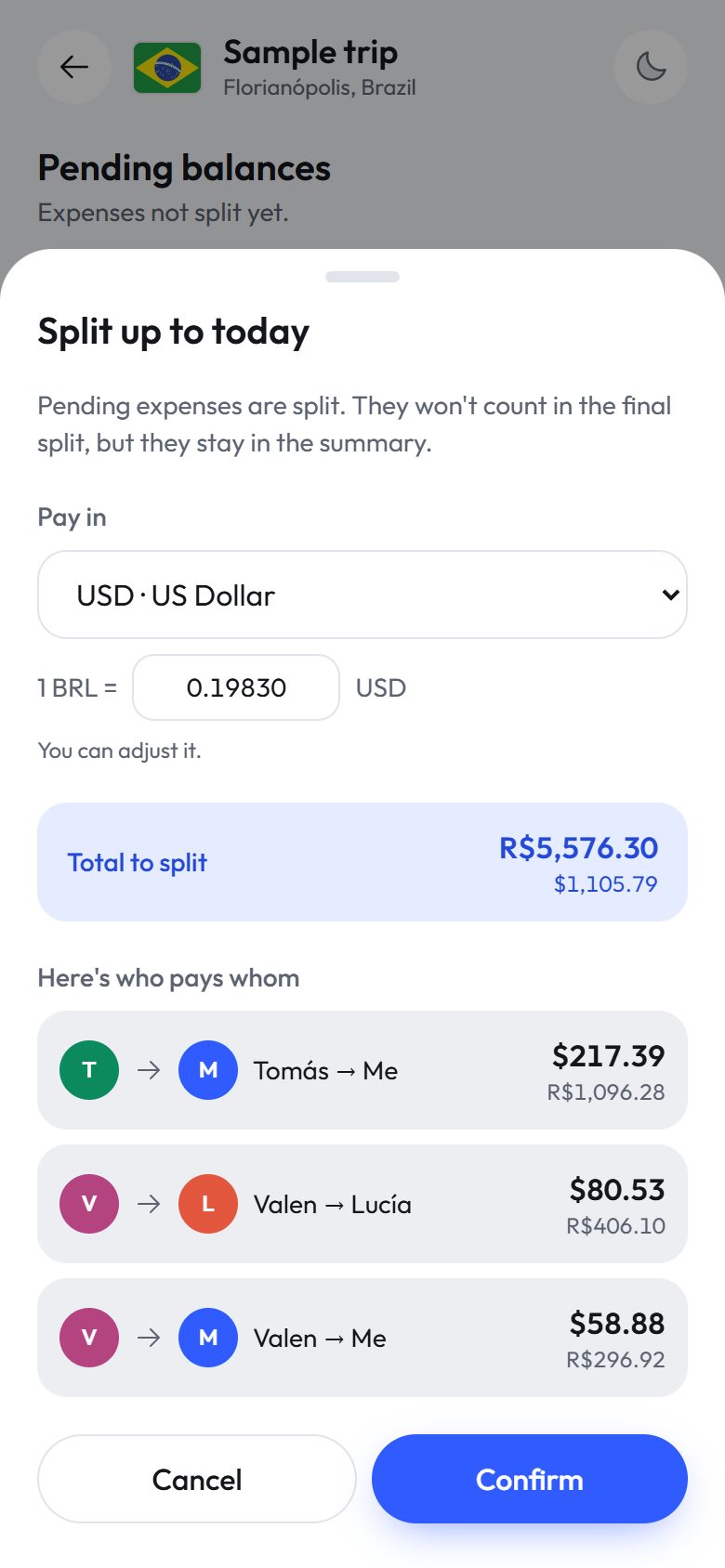
More on this in how to handle travel expenses in multiple currencies.
Before you leave: a quick check
- Look up your card's foreign transaction fee and ATM fees abroad.
- Make sure your card works internationally and that your bank's app lets you lock or unlock it.
- Note the approximate exchange rate so you can spot a bad deal.
- Decide with your group which currency you'll use to pay each other back.
To see what a price abroad means in your own currency, use the travel currency converter. To plan the trip before you go, see the solo travel budget guide.
FAQ
Do I still need to tell my bank I'm traveling?
Many banks no longer require it, but some still flag foreign purchases. Check your bank's app; a two-minute setting can save you a blocked card on day one.
Is it worth getting a travel card or multi-currency account?
If you travel more than once or twice a year, often yes: fee-free spending and better exchange rates add up. Compare fees and how easy it is to top up before choosing.